

TRUCK operators in Scotland are being invited to test an innovative new planning tool designed to explore what happens when HGVs switch from diesel to electric.
Hoped to rapidly accelerate the decarbonisation of road freight in the country, the ScotVolt interactive dashboard has been developed for Transport Scotland by researchers based at Heriot-Watt University with The Centre for Sustainable Road Freight.
Truck fleet owners and operators, hauliers, delivery companies, and logistics firms are now being invited to test the tool against their own routes and submit feedback.
Using sophisticated computer modelling techniques and data from around 80,000 real truck journeys in Scotland, ScotVolt allows users to test different routing and charging scenarios to see where electric HGV chargers would be needed, how much electricity they would draw, and whether the local electricity grid can handle it.
The dashboard draws on two years of research commissioned by Transport Scotland and the Scottish Government through their HGV Decarbonisation Pathway for Scotland, published in March 2024 to help transition heavy goods vehicles to zero-emission technology.
Stephen Flynn, Scottish Government cabinet secretary for economy, tourism, and transport, said, “We pledged in our HGV decarbonisation pathway for Scotland to work collaboratively with industry to understand and overcome the barriers to zero emission HGVs in Scotland. The development of ScotVolt is a critical milestone in this work. It gives us a better understanding of what electric truck charging infrastructure is needed in Scotland – and helps operators explore their own transition to zero emission HGVs.”
Professor Phil Greening, a logistics specialist at Heriot-Watt University and deputy director of The Centre for Sustainable Road Freight, added, “One of the main barriers to decarbonising road freight is the inherent risk and uncertainty involved in such a large-scale transformation. It’s difficult for governments or businesses to invest in zero emission vehicles or technologies without a clear understanding of what this involves and what impact it could have. This is where computer modelling tools like ScotVolt can use real-world data to provide some answers – and derisk decision-making around freight decarbonisation.”
Covering six key freight corridors across Scotland – the A9, A90, A1, M74, A77 and A75 – ScotVolt runs simulations over a one-year timeframe across 56 different scenarios. These reflect different variables including vehicle battery size, the availability, and speed of charging stations and whether or not fleet depots can charge their trucks overnight.
The dashboard also captures seasonal swings in energy consumption between summer and the colder months of winter – when electric vehicle batteries tend to use more energy.
Dr Siti Fariya, a transport and logistics researcher at Heriot-Watt University, commented, “Truck operators can test our tool by starting with a scenario their know. They can pick a season, route, depot type and battery size that matches one of their own routes and then load it. They can then flip any of the variables to see the impact. For example, what happens if they switch from 500 to 1000 kWh vehicle battery? Or if they instal electric charging bays in their depot? Ultimately our aim is to help fleet owners and operators make decisions about their own transition to electric trucks.”
Chris Ashley, net zero lead for the Road Haulage Association, said, “Our members are already bringing electric vehicles into their fleets. But where and how those fleets will charge is still uncertain for many operators. ScotVolt sheds welcome light on this question and gives operators a practical tool to test their own real-world scenarios.”
The Scottish Wholesale Association represents Scotland’s food and drink wholesale sector and has supported the development of the ScotVolt dashboard. Colin Smith, Chief Executive, said: “Our own trials have shown that electric HGVs can match, and in some cases exceed, diesel performance on local wholesale delivery routes. The challenge now is making sure Scotland has the right charging infrastructure in the right places to give businesses the confidence to make that transition.
“ScotVolt is a valuable tool because it uses real-world freight data to help identify where charging will be needed and allows operators to explore what electrification could mean for their own routes. That kind of evidence will be vital in helping industry, along with infrastructure providers, plan effectively and accelerate the transition to zero-emission road freight.”
The six key freight corridors mapped in the dashboard are the A9 Highlands route from Eurocentral to Inverness; the A90 North Eastroute from Eurocentral to Aberdeen; the A1 East Coast route from Bathgate to Newcastle; the M74 West Border route from Bathgate to Carlisle; the A77 Western Port route from Bathgate to Cairnryan and the A75 South West route from Carlistle to Cairnryan.
The charging sites in ScotVolt’s dashboard include existing and planned sites that are already operational or in construction, and other locations where researchers have identified that charging infrastructure will be needed.
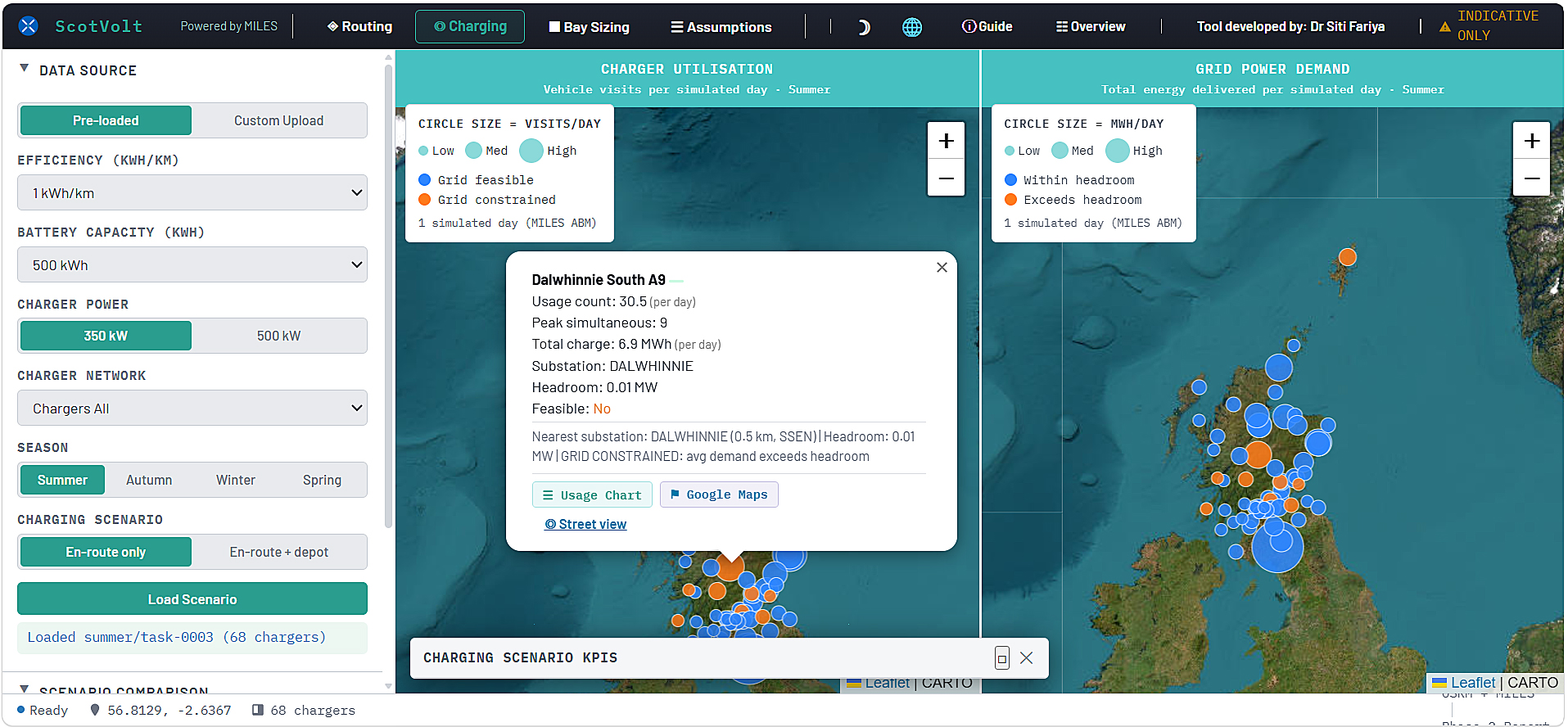
Two side-by-side maps in the dashboard show how many vehicles visit each charger (left-hand map) and how much energy they draw from the grid (right-hand map). Users can also see how many charging bays each site needs – estimated using simulation data – and which charger stops on different routes a truck would need based on its battery range and local charger locations. Users can also build custom routes between any two hubs.
The maps also show the nearest electricity substation, where they exist, that would supply each charger, and whether the charging demand meets or exceeds what the electricity grid can supply. Popups on the maps show details including how many vehicles visited a particular charger in the simulated day; the maximum number of vehicles charging at the same time during the day and total electricity delivered to all vehicles at this site during the day.
To build ScotVolt, the researchers used a computer simulation technique called agent-based modelling. This models how individual agents – people or things – interact with each other and their environment.