
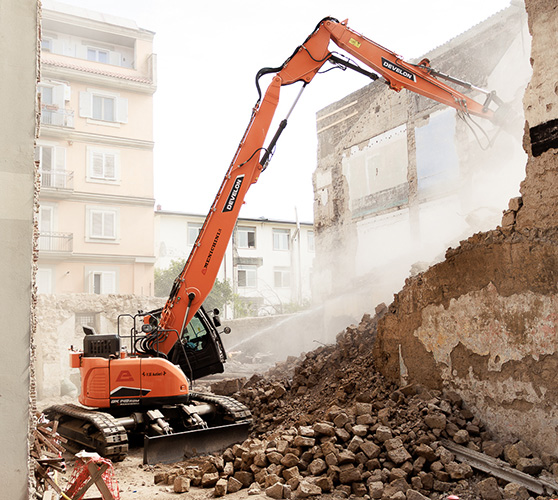
A Develon DX140RDM-7 demolition excavator has taken down a historic building next to the Royal Palace of Caserta in Italy.
Working in an urban area, surrounded by occupied buildings, the project involved demolishing a structure approximately 15m-high, built in a material called tuff and dating back to the 19th century. The old building is making way for a new residential complex comprising 24 housing units.
The structure was made predominantly of tuff, a material widely used in historic Campanian construction, but one characterised by a relatively fragile structure and cohesion that can vary considerably.
Undertaking the task was Ecorif Srl, a company based in Campania that specialises in demolition. The DX140RDM-7 digger was supplied by Edilnoleggi, the local Develon importer and distributor.
Ecorif previously operated a DX340 demolition excavator from the Develon range, equipped with a 20-metre boom. When the need arose for a more compact machine capable of working on urban sites and in locations that are more difficult to access, the firm opted for the DX140RDM-7.
To reach the work area in the city centre, the model was equipped with steel tracks fitted with heavy-duty rubber road liners. This allowed the machine to travel over asphalt without damaging the road surface. Once on site, the machine was able to take advantage of its compact dimensions to access particularly confined areas. Develon explained that the variable-width undercarriage also made it possible to combine easy access and transport with the stability required during demolition operations. The undercarriage can be retracted to just 2.5m and hydraulically extended to 3.7m.
The DX140RDM-7 worked with a demolition grapple, allowing the operator to tackle the tuff structures with an extremely high degree of precision, Develon added.
The machine’s demolition-specific configuration is enhanced by a cab that tilts by up to 30°, providing ‘excellent’ visibility during work at height; Level 2 FOGS protection; dedicated auxiliary lines for different attachments and a stability warning system with hydraulic lockout.
The demolition process was completed in just over a month, despite the challenges posed by the building’s location, the surrounding homes, and the particular construction characteristics.
“We are extremely satisfied with our new purchase,” said Nicola Autieri, MD of Ecorif. “The DX140RDM-7 has all the advantages of a compact machine, but its performance is comparable to that of an excavator weighing more than 30 tonne. It is manoeuvrable, precise, comfortable and perfectly stable, providing excellent productivity and low fuel consumption.”
Ecorif’s work didn’t end with the demolition of the building. The project is part of a broader process that also includes the transport and recovery of demolition materials.
The material generated during the Caserta project was transported to the inert-material crushing plant operated by DIAF Srl, managed by Antonio Autieri, Nicola Autieri’s brother. Here, through processing, the material recovered was transformed into aggregate suitable for use in the construction sector.