
Dan Gilkes reports from America on JCB’s successful attempt to break the land speed world record
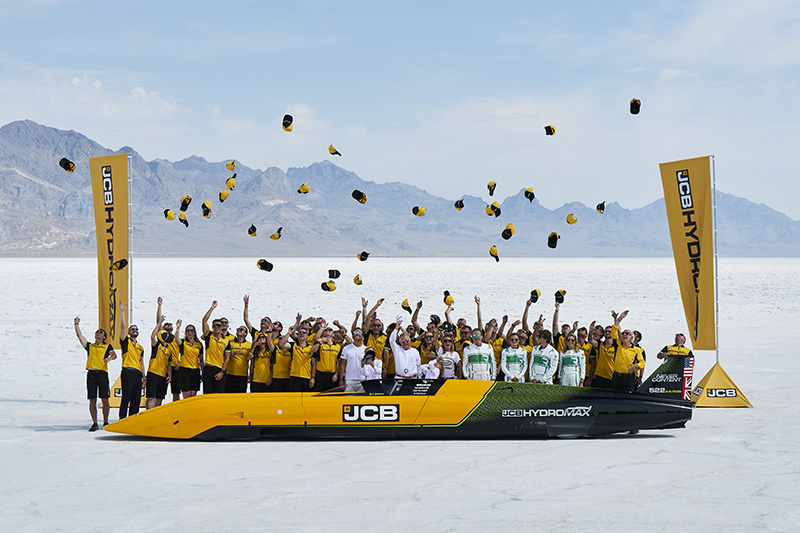
Global plant and equipment manufacturer JCB has set a second World Land Speed Record on the Bonneville Salt Flats in Utah, USA. The zero emission JCB Hydromax car, driven by Wing Commander Andy Green, the world’s fastest man, achieved an average over two measured mile runs of 406.320mph (653.909km/h). This set a new speed record for a car powered by hydrogen engines, following the company’s diesel-powered record, set at the same location 20 years ago.
“This achievement is about more than going fast,” said Lord Bamford. “It is about demonstrating engineering solutions, that the internal combustion engine powered by hydrogen can be part of the solution for the future.
“We hear constantly about global warming and the need to reduce the world’s dependence on fossil fuels and their emissions. I believe very strongly that the internal combustion engine, powered by hydrogen, can be one of the important solutions for the future. At its heart, this technology is based upon the engines and engineering principles that we understand and that we use every day in construction machinery around the world.
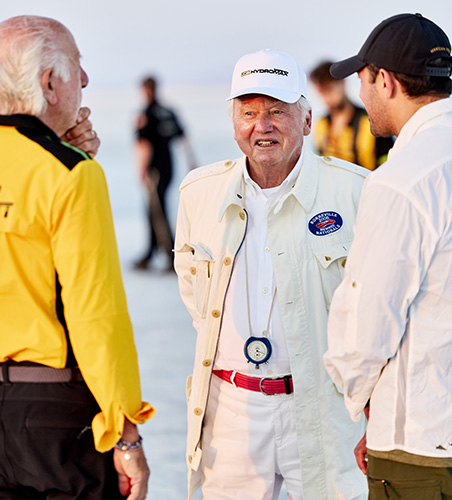
“This technology is based on the machines that we are building today. It proves that we are still designing, still engineering and still prepared to take risks. The internal-combustion engine powered by hydrogen can be one of the important solutions for the future, particularly for the heavy-duty machinery that builds our roads, our homes, our cities and our infrastructure.”
The JCB Hydromax team was set the challenge of designing, engineering and then running a hydrogen powered land speed car just over a year ago, as part of chairman Lord Bamford’s £100 million drive to show that hydrogen is a viable fuel for construction and agricultural equipment. The company has already launched its first commercially available hydrogen machinery, a generator set and the 3CX Hydrogen backhoe loader. It has also demonstrated how the necessary infrastructure can be created for this machinery to operate on a zero carbon site today.
JCB engineering director and project leader Ryan Ballard added, “This record belongs to the engineering team, which took a hydrogen digger engine and made it the fastest of its kind on earth. This has been an amazing challenge. We came here fully prepared and the car delivered.”
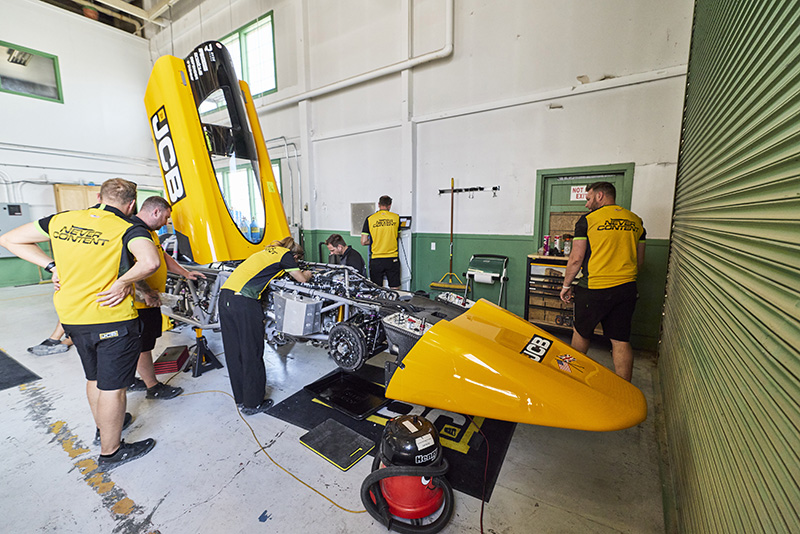
The company called on long-time collaborators Prodrive to help with the design of the car and Ricardo to assist with development of the engines, in part as JCB’s own dynamometers are designed to work with outputs of 300-400hp, well below the 800hp achieved by the car’s engines.
Ryze Power supplied the hydrogen on site, while Goodyear developed a unique set of tyres, capable of achieving the desired speeds. In total, a team of 65 was assembled, including 25 staff from within JCB’s own varied engineering divisions, whose day jobs involve designing and engineering the next generation of construction equipment.
The car arrived in the US in time for the annual Speed Week in August, where cars and motorcycles take on the challenge of breaking various speed records on the Bonneville salt. Under the control of the South California Timing Association (SCTA), the team achieved an SCTA record of 368.347mph, while running with two engines each developing around 600hp.
JCB swapped those engines in favour of new motors, checked and sealed at the factory in the UK by the FIA (Federation Internationale de l’Automobile). These promised up to 800hp each, indicating that higher speeds were still to come.
To achieve an FIA-approved Land Speed Record, the car travels along a 10-mile course, marked on the compacted salt surface. It is timed through mile 5.5-6.5 in one direction, then turned around, refuelled run through the same measured mile in the opposite direction, all within one hour.
While that may sound simple, the receiving team is 10 miles from the start line, which requires a lot of logistics. At 32-foot long JCB Hydromax has not been designed to make three-point turns, so it is loaded the car onto a trailer to make rotating it through 180 degrees easier. Every time the car was run above 300mph it was necessary to fit a new set of tyres, while up to 250kg of ice had to be loaded into the cooling system, melting as the car completed each run.
The six-speed gearbox, that passes drive from the two engines to both axles, is designed to function from around 50mph, making it necessary for a powerful Land Rover Defender Octa to push the JCB Hydromax up to that speed, before Andy Green could engage drive. The two engines produce so much torque, that it was necessary to limit their performance in first and second gears, to prevent wheelspin on the ever-changing salt surface. Green then accelerated through the first four miles, to enter the timed mile at a desired speed of around 410-415mph.
He would then turn off the engines while still in that flying mile to start the slowing process, purge any remaining hydrogen from the engines and help with cooling. JCB Hydromax is fitted with powerful carbon brakes that are used to slow from 200-100mph. The engines were then declutched before the first of two parachutes was deployed. A second parachute was deployed to bring the car to a halt.
“There have been tremendous contributions from JCB people all around the world,” said Lord Bamford. “That is incredibly important to JCB. We are not demonstrating a technology that exists only in a laboratory. At its heart, this technology is based upon the engines and engineering principles that we understand and that we use every day in construction machinery around the world.”