
Dan Gilkes gets behind the wheel of the new JCB 3CX Hydrogen backhoe loader, as equipment manufacturers invest in greener machines that deliver comparable performance to diesel models
AS the world continues to warm, there is increasing pressure on contractors, local authorities and their suppliers, to provide equipment that emits less, if any, carbon emissions. Electric cars now make up more than a quarter of the market in the UK, while batteries power just under 10% of the new van fleet and a growing percentage of the UK’s trucks.
Battery power is also becoming increasingly popular for smaller plant and machinery, with the majority of manufacturers offering at least one electric mini-excavator or compact loader. Battery electric does have its drawbacks though, not least the infrastructure to charge, particularly on greenfield construction sites.
One possible solution is hydrogen. Hydrogen can be produced locally, can be transported to site, and produces zero carbon when used. Initially, manufacturers with an interest in hydrogen concentrated on fuel cells, already seen in passenger cars and trucks. The fuel cell converts the chemical energy of hydrogen and oxygen to create electricity, with the only emission being water.
However, while several manufacturers are working with fuel cell technology, others felt that it was too complex, too delicate for construction use, and simply wasn’t the right solution for heavy plant. Attention then turned to burning hydrogen as a fuel, in an engine similar to a petrol or diesel engine. This produces no carbon emissions and allows the manufacturer to use the same engine bay, transmissions and hydraulic pumps as a diesel model.
At the head of this pioneering movement is UK manufacturer JCB. Chairman Lord Bamford charged his engineers with creating a hydrogen-fuelled engine, based on the company’s own diesel engines produced in Derby. Providing those engineers with £100 million of investment, the result is a hydrogen version of the firm’s 4.8-litre four-cylinder engine.
The hydrogen motor produces the same 55kW (74hp) and 440Nm of torque as the diesel engine that is also available in the 3CX. It sits within the same engine bay, drives through a similar transmission and, in extensive customer testing, offers much the same driving experience as its diesel counterpart.
The company is also set to employ two of the hydrogen engines, producing around 800hp each, to power a world land speed car in the USA later this summer, as JCB once again looks to set records on the Bonneville Salt Flats.
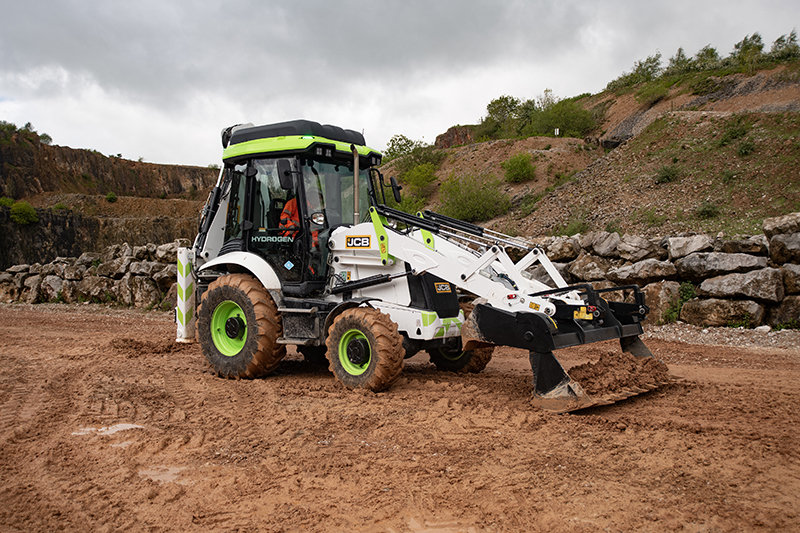
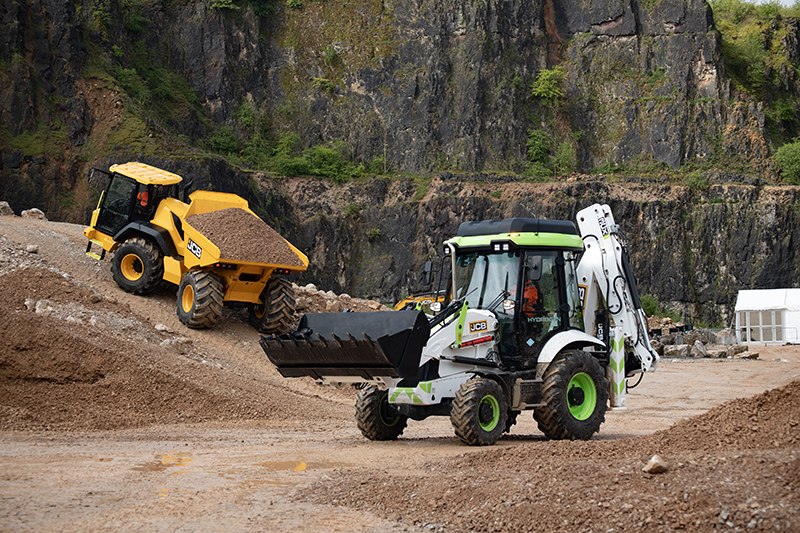
Closer to home, that technology is now being launched in a commercially available machine, the 3CX Hydrogen. The only visible difference from the outside, apart from the white and green livery, is a cap on the roof of the cab. This contains three hydrogen storage tanks, made of aluminium and wrapped in carbon fibre.
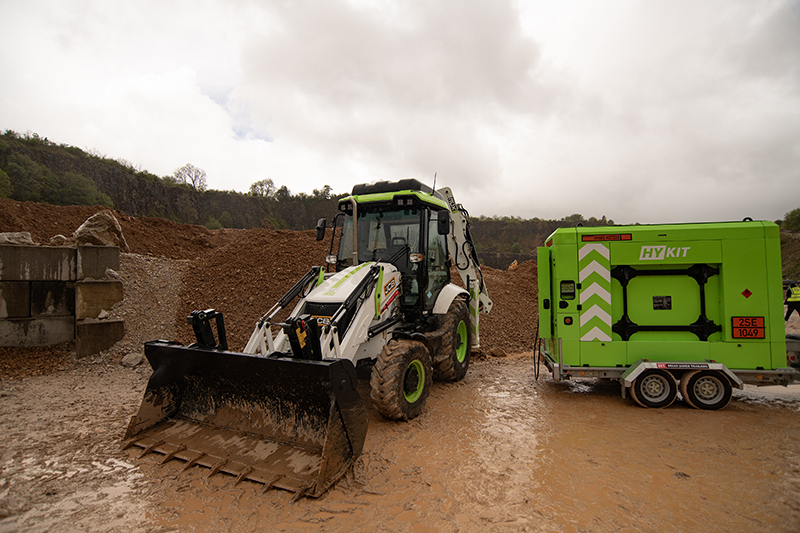
The hydrogen is stored at 350 bar pressure, feeding the engine at less than 20 bar and the tanks have enough fuel to operate for a full shift. Critically, refuelling takes around the same time as a diesel tank, so there is none of the parking up for 8-10 hours that is associated with a battery electric machine.
JCB’s hydrogen engine has been fully Type Approved for use in non-road mobile machinery across the EU. It is also approved for use on the road, allowing the backhoe loader to make its own way to and from sites, with no carbon footprint.
The 3CX Hydrogen drives through a six-speed autoshift transmission with torque lock, permitting a maximum travel speed of up to 40kph. It offers the same all-wheel drive traction as its diesel counterpart and delivers similar performance with the front loader and the backhoe.
Indeed, climb into the spacious cab and there is little to tell the operator that the machine is any different to any other 3CX. The seat is comfortable, visibility is good all-round helped by LED working lights, there is Bluetooth connectivity and hands-free mobile phone operation. A 7” display to the right of the seat keeps the operator up to speed with operating data and can even provide how-to videos for new drivers.
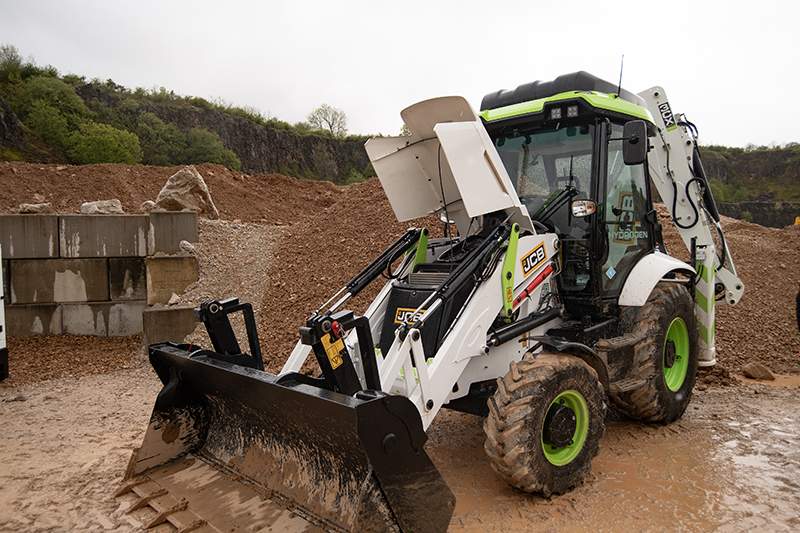
The engine reacts just like the diesel too, providing easy acceleration, smooth gear shifting and strong front loader performance. JCB claims that the six-in-one front shovel can load a 20-tonne truck in under five minutes and it offers all of the versatility to grade, load, dig and backfill that has made the backhoe loader a favourite with owner operators and contractors across the world.
Standard Auto SRS loader arm suspension reduces bounce in the loader arms when travelling, reducing spillage and boosting productivity in load and carry applications.
Tilt the steering column forward, spin the seat and the same excavator-style servo levers take controls of the backhoe. JCB claims up to 190 tonnes/hour can be excavated with a 0.48m3 bucket and the standard extending dipper gives a reach of up to 6.5m, just like the diesel machines.
The hydrogen machine can of course be used with all of the attachments that are available for the diesel 3CX, adding to its versatility.
So where do you get the hydrogen from? Unlike passenger cars, construction equipment can’t visit public filling stations and has much more controlled fuelling networks. While hydrogen can be produced at a central site, making it mobile was more of a challenge.
JCB has partnered with HYKIT, a hydrogen equipment company, to develop a mobile on-site refuelling solution.
Mounted on a trailer, or in multiples on a larger truck, the smallest refueller contains enough hydrogen for a week’s worth of backhoe loader use. Once empty, the refueller is taken away and refilled.
For much larger, longer duration sites, where there might be multiple hydrogen-powered machines, generators and other equipment working, it could even be possible to produce the hydrogen on site, through electrolysis, using renewable power sources like solar and wind power.
In a typical chicken and egg situation, the growing uptake in electric vehicles has resulted in numerous charging providers setting up EV charging sites.
As the number of hydrogen machines starts to grow, it is likely that additional hydrogen production sites will come online.
There is no single solution to carbon reduction in construction equipment. Instead, there will be multiple solutions, including battery electric and now hydrogen. The 3CX Hydrogen proves that opting for a zero-carbon machine should have no effect on productivity and performance.