

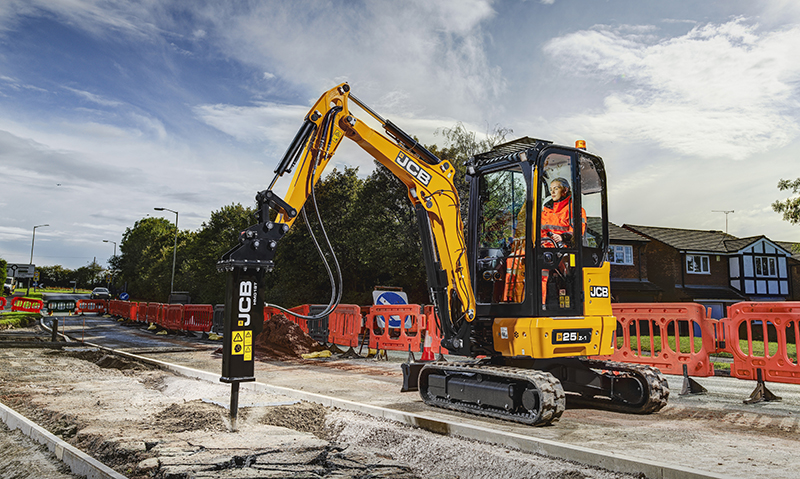
WITH the addition of new models for 1-10 tonne carrier machines, JCB says its Contractor breakers now deliver ‘performance, durability and efficiency’ across the toughest applications for models spanning from one to 60-tonnes.
The JCB Contractor breaker range from JCB Attachments is designed for applications across construction, demolition and quarrying. The launch of breakers built for 1-10-tonne carrier machines means the same destructive performance can be delivered on sites where more compact equipment is necessary.
Comprising 14 models, JCB explained that the range is compatible with carrier machines from one to 60-tonnes. Each breaker is tested and matched to work with JCB excavators, backhoe loaders and compact equipment, ensuring the correct hydraulic flow, pressure and fitment. The breakers are also compatible with other brands of excavator and tool carrier, making them a flexible solution for mixed fleets.
Daniel Glenister, JCB Attachments business head, said, “JCB Contractor breakers are designed to work as part of a complete machine and attachment package, ensuring compatibility and consistent performance on site. Features such as internal control valves, accumulators and auto-stop functionality improve efficiency and protect both the breaker and the carrier machine.
“For contractors and rental businesses, the range offers a practical solution with the durability, ease of use and support expected of a genuine JCB product.”
The larger Contractor breakers are equipped with accumulators, helping to protect the carrier machine from hydraulic pressure spikes and reducing wear on the hydraulic system. Models for machines of eight tonnes and above feature a refillable auto greasing system as standard, ensuring the breaker receives the correct level of lubrication throughout the working day.
Twin oval tool retaining pins on heavier models are designed to deliver double the life of a standard pin, as they can be rotated to wear on both sides, while smaller breakers use a single tool retainer.
Two-speed control valves allow operators to adjust tool speed and stroke length depending on the material being broken, while internal control valves improve oil flow and reduce heat build-up within the system. Heavier models also include blank firing protection.