

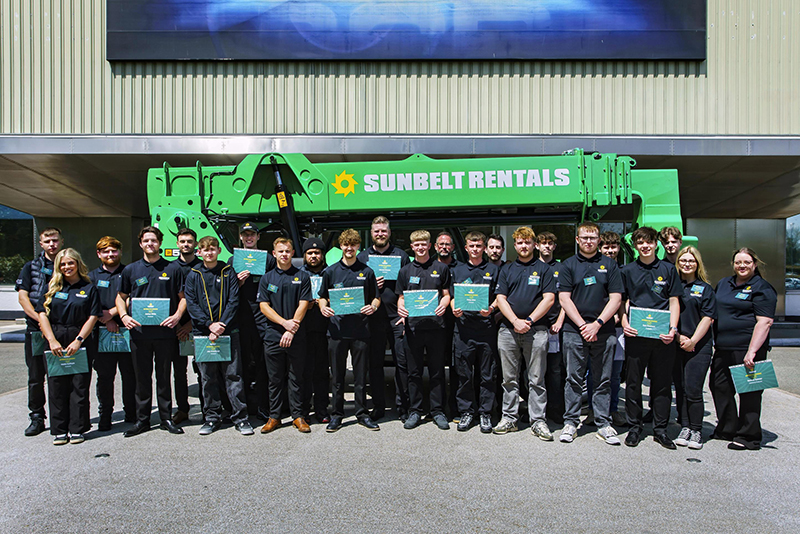
Julie Harpley, early careers & social impact academy manager, and Jenny Parry, head of talent at Sunbelt Rentals UK and Ireland discuss the growing skills gap in engineering and how they’ve tailored their apprenticeship programmes to ensure they meet the business needs for both the present day and the future.
DATA shows that 76% of engineering employers are struggling to recruit for critical roles, and at Sunbelt Rentals UK & Ireland, we are seeing that challenge first-hand. Our Engineering Director is actively recruiting electricians and electrical engineers across the country, yet too many of these roles remain difficult to fill, reflecting a long-term skills pipeline challenge that has been building for decades.
The cause; a generation of highly experienced engineers in their 50s and 60s approaching retirement. At the same time, the cohort that should have followed them, the skilled technicians and engineers are smaller than the industry needs. This reflects a period when vocational training did not receive the attention or investment it deserved, and the skills the industry requires are evolving, with education providers now working to catch up.
The result is a skills gap that cannot be solved through recruitment alone. It needs to be developed deliberately, with talent nurtured in a way that reflects the needs of the business today while building capability for the future.
The need for immediate action
What makes this moment particularly critical is the pace at which skills requirements are changing, especially in the hire industry and advancing equipment is increasingly sophisticated. Modern plant and powered access machinery demands specialist, continually updated knowledge from the engineers who service and maintain it.
Julie highlights: “Skills requirements are changing so rapidly that apprenticeship frameworks are almost out of date before they’re fully implemented. Plus, the advancement in technology and the complexity of new equipment can mean that some training programmes may already require revision before they have been fully rolled out.”
It’s not just about engineers needing more knowledge; the ability to keep learning, adapt, stay curious, and pick up new skills as the industry changes is now a fundamental technical skill in itself.
Apprenticeships: qualifications and experience
There is still a stubborn perception problem around apprenticeships in engineering. For many parents, teachers and even employers, the apprenticeship route is viewed as the alternative to a ‘proper’ career, a pragmatic fallback, not a purposeful choice. That perception is increasingly at odds with reality.
Modern engineering apprenticeships, like the ones we provide at Sunbelt Rentals can reach Level 4 and beyond. Providing genuine, high-level qualifications with something a university degree almost never offers: a guaranteed job and real-world experience at the end of it.
We’ve noticed in the industry that graduate entry-level roles are at an all-time low. Employers across industry are demanding people who can contribute from day one. The practical, applied foundation an apprenticeship builds is exactly what industry values right now.
At Sunbelt Rentals, our programmes have been more competitive this year than at any point in our history. We are seeing applicants with existing vocational qualifications and candidates who hold degrees choosing our apprenticeship route because they understand the pathway is strong.
Schools are changing too with careers advisers who would not have raised apprenticeships as an option a few years ago are now actively encouraging them. When young people and their families see it as a genuine professional route, the quality and ambition of those applying changes dramatically.
Planning for the future
The most common mistake organisations make with apprenticeships is treating them as an off-the-shelf solution. They identify a gap, select an existing standard framework and assume the work is done. Whereas we see the standard frameworks are a foundation, not a finished product. If you want apprentices who are genuinely useful to your business, you need to build programmes around what your business actually needs including what it will need in two or three years’ time.
At Sunbelt Rentals, every year, we sit down with our business to map the gaps: not just the immediate vacancies, but the capabilities the business will require as it evolves. From those conversations, we determine what exists, what can be adapted and what needs to be built from scratch. Very little of what we do now maps neatly onto any existing framework. Therefore, we use the frameworks as a spine and build the programme around them.
“You need to know your business commercially to design apprenticeships that genuinely serve it. That includes having the confidence to push back on our training partners to be delivering the training and skills development we need, to ensure the best for our people and customers.” Jenny adds.
Commercial awareness is critical, particularly when considering future capability and succession planning for the business. We have had requests that may initially focus on an immediate replacement need, while a Level 3 or Level 4 apprenticeship would offer stronger alignment with the longer-term requirements and the wider direction of the business. The opportunity is to shape a solution that best supports the future business needs.
The Multi-Skilled Engineer
Our flagship Multi-Skilled Engineer programme is the clearest expression of this philosophy. We built this programme in partnership with our training provider using existing apprenticeship standards as the curriculum core, then layered in bespoke modules and a rotational structure that exposes engineers to the full range of our product categories.
The ambition is not simply to develop technical competence in a narrow field, but to build engineers with the breadth, credibility and commercial awareness to operate confidently in a more integrated, customer focused environment. We want our engineers to understand our customers’ businesses, spend time on their sites, assess their needs across the full range of solutions we offer, and engage with the confidence and authority that comes from genuine expertise. That is the proposition we’re building towards as a full-service solutions provider and the talent strategy to reflect it.
Critically, the programme is also designed to develop the qualities that will matter most in a changing environment; problem-solving mindset, curiosity and adaptability that will remain valuable even as technology continues to shift.
That is why we see apprenticeships as far more than a route into today’s roles. They are a way to shape the capability we will need tomorrow. We are training for the engineer of the future.
Support that goes beyond the qualification
The quality of wraparound support is where most apprenticeship programmes either earn or lose long-term returns. A qualification achieved in isolation without mentoring, community or sustained development rarely translates into retention and progression.
Our investment is in the individual, focusing on the whole person and their aspirations. We achieve this by selecting the right training provider, ensuring well-trained mentors are available in their depots and hosting monthly wellbeing drop-ins. These sessions cover essential practical realities for success in a first professional role, such as financial literacy, nutrition and fitness.
The same principle applies to professional development. Skills workshops, face-to-face cohort inductions, and regular college visits to maintain quality standards. And it means the relationship does not end when the qualification is achieved. Many of our apprentice graduates return to mentor new cohorts, participate in assessment centres and develop their own leadership capabilities. In doing so, apprenticeships become the foundation for a long-term talent pipeline.
Our commitment goes beyond a two-year programme; we guarantee a job upon completion of our apprenticeships and ensure a commitment to the apprentice’s subsequent career development. We also offer professional skills training which aims to develop their wider skills for the real world, these include advice and drop-in sessions on finance, pay slips, understanding tax codes, nutrition, well-being and so much more to ensure they’re well versed in the world of work and living.
In an industry facing the structural talent challenges ours is, retention is not a secondary concern it is equal in importance to recruitment. Businesses that build resilience for the future will be those that recognise apprenticeship success is not defined at the point of enrolment or even qualification, but in the careers that follow.
What does this mean for the hire sector?
The hire industry, and the broader engineering and construction ecosystem, cannot resolve a structural talent shortage through lateral hiring alone. The experienced engineers who built the sector’s capabilities are leaving the workforce and there are not enough mid-career professionals to replace them. The only sustainable answer is to build new talent from the ground up, with programmes that are genuinely designed for business needs, properly resourced and treated as a long-term strategic investment.
That requires organisations to stop treating apprenticeships as a compliance exercise or a short-term cost reduction measure, and start treating them as what they actually are: the most direct route to the workforce the industry needs.
This requires commercial ambition in programme design, genuine investment in support infrastructure, and the honesty to ask not just what we need people to know today, but what we will need them to do tomorrow.
The skills gap is not a projection, it is already here. The businesses that will come through it strongest are the ones building their pipelines now.