
AERIAL work platform specialist Sinoboom has launched a new collision avoidance system for scissor lifts and mast lifts.
The solution is designed to address the shortcomings of standard single-sensor systems currently in the market, such as detection blind spots, high rates of false alarms, and lack of adaptability to multiple scenarios.
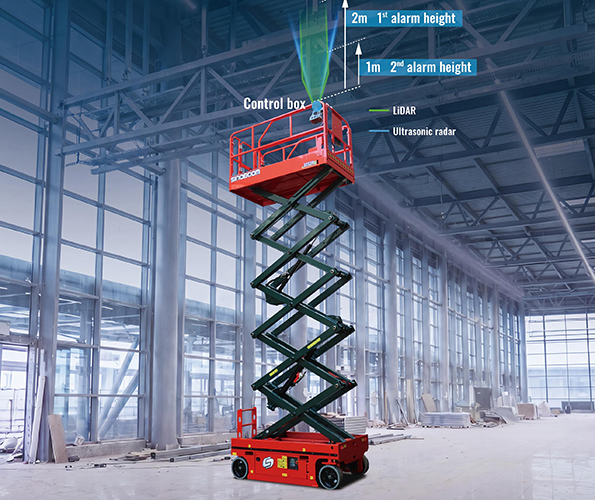
The Collision Avoidance Radar System (CARS) for scissor lifts deploys multiple sensors, mounted on the platform rail in a compact casing and connected to the control unit. Alarms are triggered by overhead obstacles in two stages, with the automatic restriction of the lift’s movement also triggered in the second stage, protecting operators against impact with the obstacle.
CARS has been developed to be compatible with both older and more recent Sinoboom scissor lift control systems, though the operating experience is slightly different between the two systems.
The first stage of alarms is triggered when an obstacle is detected between one and two metres overhead. The rail-mounted CARS unit displays a flashing indicator and sounds a buzzer alarm, while the integral scissor lift’s alarm is also sounded. With newer control systems, both lifting and driving operations are also automatically slowed down in the first stage.
In the second alarm stage, when an obstacle is detected at less than one metre overhead, both lifting and driving movements are automatically restricted, alongside the CARS unit’s and scissor lift’s audible and visual alarms.
For additional flexibility, the distance-to-obstacle setting can be adjusted depending on the height of individual operators.
Sinoboom explained that the patented system represents three key technological breakthroughs:
- Dual-sensor synergy: CARS combines the advantages of an ultrasonic sensor with ±20° wide coverage, and a LiDAR sensor which provides full-range detection from 0-3 metres.
- One-button calibration: The operational alarm distance can be adjusted to account for the operator’s height. The primary alarm distance can be adjusted in a range between 0.6m and 2.5m, while the secondary alarm will automatically extend the one-metre buffer zone.
- Emergency override mode: A button on the control unit can be utilised for temporary continuation of operations, with protection being restored upon the button’s release to ensure ongoing safety and productivity.