

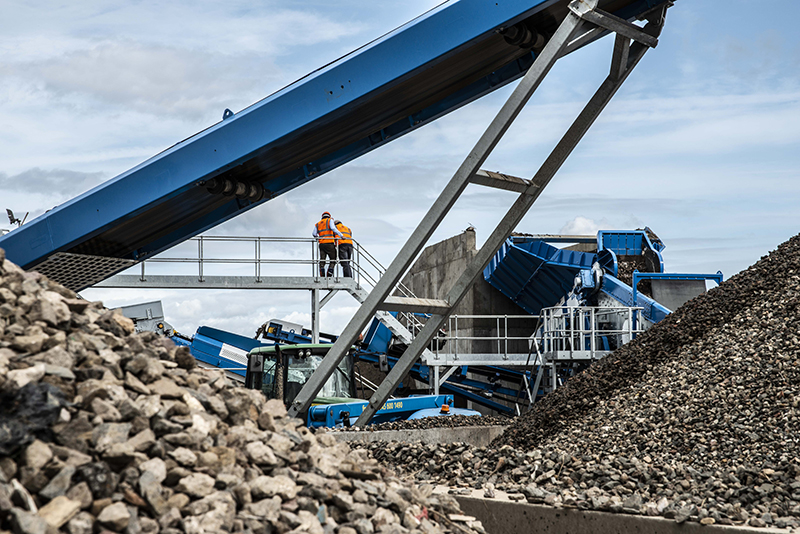
Scott Brewster, MD of Brewster Brothers, a resource management company with wash plants near Livingston and Cumbernauld, answers Project Plant’s questions about the Scottish construction sector’s ongoing journey towards a more sustainable future
Q) Where do you think the Scottish construction industry is right now in terms of its sustainability journey?
A) Scotland’s construction sector currently consumes 50% of the country’s natural resources, generates 50% of its waste, and together with the built environment accounts for 40% of its carbon emissions. Clearly, there is some distance to go in the decarbonisation journey, and this challenge is only becoming more pressing.
Addressing Scotland’s housing emergency means building more homes. Improving the condition of our nation’s public infrastructure – schools, hospitals and roads – all require enormous amounts of aggregates. And so, too, will the delivery of renewable energy projects and associated infrastructure that will defend us against climate change, which is a major strategic priority for the Scottish Government. Recycled aggregates provide a standard and competitive means of addressing the challenge with natural resource use and waste. And, given that it is highly unlikely that the need for sand, gravel and concrete will diminish any time soon, there’s both a commercial and environmental imperative to encourage greater use of sustainably produced materials in Scottish construction.
Q) What can be done to accelerate adoption of more sustainable practices?
A) The implementation of the new Scottish Aggregates Tax will give Scottish ministers a fiscal lever for the first time to stimulate the adoption of more sustainable practices in the construction sector. However, this is just the tip of the iceberg. Given the finite nature of virgin material supplies, there is a clear commercial and environmental incentive for the construction industry to adopt recycled aggregates as a practical and readily available alternative. To fully realise this opportunity, bold action is needed to make recycled products the default, rather than an option ‘where possible’.
This could be done by Scottish ministers joining up policy priorities across decarbonisation targets, planning policy and building standards, alongside fiscal instruments such as the Scottish Aggregates Tax and the Scottish Landfill Tax. Behaviours can’t be changed in isolation: rather, an equal application of carrot and stick will create the right incentive and operating environment to encourage the adoption of more sustainable practices in this sector.
Q) Have you been encouraged by the sector’s response to more ambitious environmental targets in recent years?
A) There have been numerous measures initiated by both the UK and Scottish governments, as well as the industry, which set ambitious environmental benchmarks – the Scottish Passivhaus equivalent, Net Zero Public Buildings Standard and the globally-recognised BREEAM certification are all good examples which set us in the right direction. However, the overall pace of adoption across the sector has been slower than we would like. There’s still a long way to go before these measures translate into widespread practice.
This is not a problem that I lay at the door of either the sector or of policy-makers. I believe there is much more that policy-makers can do to join the dots between net zero targets, building standards, planning and industry practice. I also believe that the sector can show more willingness to innovate and adopt more sustainable practices without the need for government incentives. That’s why ongoing investment from companies like Brewster Brothers in sustainable processes and new, innovative materials are all the more important.
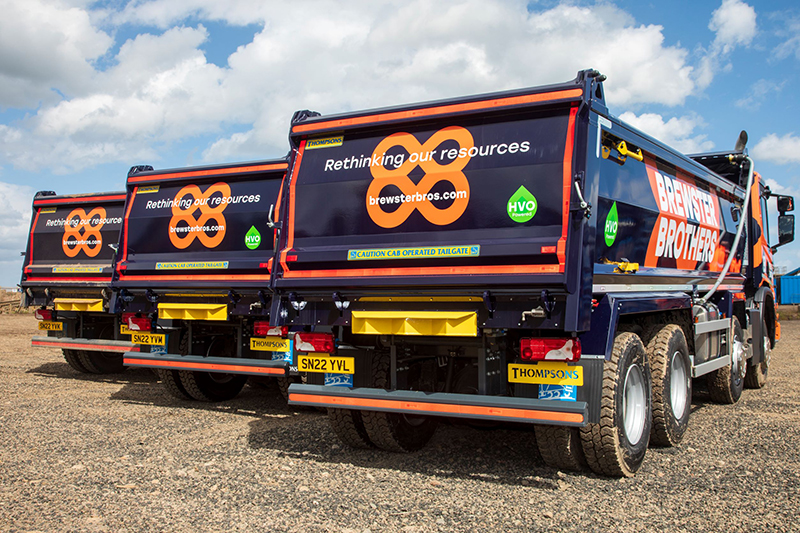
Q) What impact do you envisage the Scottish Aggregates Tax having?
A) While at first glance the Scottish Aggregates Tax (SAT) may appear to be a relatively specialist area of tax policy, the SAT, along with the Scottish Landfill Tax, is an important industrial strategy tool.
With the right application, the SAT could make recycled materials the default, not the exception – driving carbon reductions across Scotland’s construction sector whilst at the same time supporting the delivery of homes, infrastructure and energy projects that are vital to Scotland’s economic growth. To that end, Brewster Brothers has worked closely with our membership organisation, the Resource Management Association Scotland, to make the case for a bold and progressive application of the SAT to ultimately discourage the extraction and use of virgin materials.
Clearly, we have a commercial interest in taking this position; however, a more competitive price differential between virgin and recycled aggregates will create a more confident environment to unlock investment in recycling infrastructure and wash plants like our own, as well as associated logistics networks – all of which are significant growth areas for Scotland’s green economy.
The Scottish Government’s most recent survey in 2019 found that there were only 18 years’ worth of sands and gravels left in Scotland’s quarries. The new SAT is therefore as timely as it is impactful in encouraging investment in a more circular construction economy. These investments are long-term and almost exclusively regionally anchored, creating skilled employment and resilient supply chains in the areas they service.
Q) What have been some of the most recent developments within the Brewster Brothers business?
A) Brewster Brothers opened its second plant, located at Gartshore near Cumbernauld, just over two years ago. This was a £7 million investment, adding capacity to recycle a further 300,000 tonnes of construction, demolition and excavation waste per year for re-use in the building trade. With this additional capacity in place, in 2025, the business celebrated the milestone of diverting two million tonnes of CDE waste from landfill between our two sites.
As part of that installation, we have included a counter flow classification unit at the Gartshore site that removes lower density materials from our sands, ensuring a clean and high-quality product. Ongoing investment in modern recycling processes such as this is helping us build our reputation as a leading supplier of high-quality aggregates, while continuing to divert millions of tonnes of waste from landfill each year.
Q) Are there any myths that persist surrounding the quality of recycled construction products?
A) One of the biggest myths that still persists around recycled construction materials is that they are inherently lower quality than virgin aggregates. Whilst this might have been the case many years ago, modern processing technology has allowed for a vast expansion of a range of high-quality recycled aggregates suited to a range of applications. However, some perceptions in the sector haven’t kept pace with these technological advances.
The continued widespread use of lower-grade crushed demolition waste, such as 6F5, has also contributed to the assumption that all recycled materials perform the same, when in reality, there is now a clear distinction between basic recycled fill and well-engineered, high-quality recycled products. The issue persists as quarried equivalents (6F2) are so price competitive, so there’s little incentive for contractors to take any perceived risk with recycled options, particularly if they’ve had bad experiences in the past. This is a continuing education-style marketing challenge for us and why our best marketing tool is welcoming prospective customers to come and see our operations in action.
At Brewster Brothers, our materials are rigorously tested and certified to the same British product standards as virgin materials, and also comply with the same application standards. The washing technology used during our modern recycling process means that recycled aggregates look (almost) identical and present no difference in the performance of the product.
In 2023, we became the first organisation in the UK to achieve an Environmental Product Declaration (EPD) for recycled aggregates. This gives our customers independently verified data on environmental performance from extraction to end-of-life, and is a clear differentiator in a market increasingly focused on sustainability metrics.
Meeting these rigorous standards and securing EPD for Brewster Brothers materials isn’t just about compliance – it gives our customers absolute confidence in our products, and helps break down the outdated perceptions about the quality of recycled aggregates.
Q) What are your ambitions for Brewster Brothers in 2026?
A) We are proud of the circular business model that Brewster Brothers has built over the last year and in previous years – diverting millions of tonnes of waste from landfill, creating high-quality aggregates and servicing a broad customer base across central Scotland.
This year, we’ll continue to build on that foundation with several projects which will boost the sustainability of the business and expand our customer offer.
I’m delighted that planning permission has recently been secured for a solar farm at our site in Drumshoreland in West Lothian. Once operational, this project will provide a clean form of energy to power the operations at the Drumshoreland site whilst also providing energy security and price certainty.
Secondly, we are exploring ways to valorise our silt and clay residual waste, turning what was previously a by-product into a usable product. This will be an exciting expansion of our customer offer and a clear demonstration of the quality and innovation that recycled aggregates can deliver.
Finally, we are embracing artificial intelligence and, later this year, will be launching a new tool to improve our internal productivity, with the ultimate aim of enhancing the service we deliver to our customers.